

On behalf of the TPB, I am pleased to contribute to this plan for 2026–27.
The TPB plays a critical role in supporting public trust and confidence in the integrity of the tax profession and the tax system. The environment in which we operate continues to evolve, shaped by changes in professional practice, emerging business models, technological developments and increasing community expectations of regulators. In this context, the TPB must be clear, consistent, and focused in how we perform our role.
In 2026–27, the TPB will build on our established strong foundations while sharpening our regulatory focus.
This includes providing greater clarity on the standards we expect from tax practitioners. Our compliance approach will remain fair and proportionate, while taking a firm stance when necessary. For 2026, our main priorities revolve around upholding the integrity, professionalism, and trust that are fundamental to the tax profession. These priorities address both new and ongoing risks, with a strong emphasis on identifying and addressing misconduct or unethical behaviour among tax practitioners. By focusing on these areas, we support practitioners who meet expectations, encourage voluntary compliance, and deliver targeted actions in close collaboration with the broader profession.
Clear regulatory signals are essential to supporting voluntary compliance and maintaining a level playing field for ethical practitioners. We will be more deliberate and targeted in our communications to positively influence the behaviours we expect to see across the tax profession.
As reforms are implemented, we will support positive behaviours across the tax profession. We will continue to work closely with professional associations and the broader profession to reduce unnecessary compliance requirements, ensuring our approach supports both integrity and efficiency across the sector.
We will operate as an agile regulator, deploying our resources to address emerging risks across the profession. To achieve this, we will continue to invest in capability and future readiness. This includes strengthening workforce capability, improving systems and data management, responding to the opportunities and risks presented by emerging technologies including AI. Strong relationships and shared responsibility remain critical to maintaining confidence in the tax system. We will continue to collaborate closely with our partners across government, including the ATO, and with professional associations and the broader tax profession.
I thank the TPB staff and Board members for their professionalism and commitment, and our stakeholders for their ongoing engagement and constructive contribution. Together, we will continue to support a strong, ethical, and trusted tax profession.
Peter de Cure AM
Chair
Tax Practitioners Board
The key elements of our plan
The following diagram represents the key elements as required in a corporate plan under subsection 16E(2) of the PGPA Rule. In addition to these requirements, we have also included our vision.
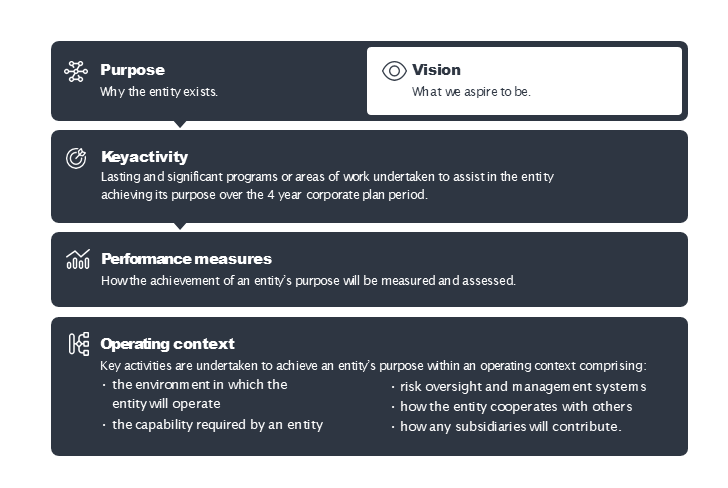
As the national body responsible for the registration and regulation of tax agents and Business Activity Statement (BAS) agents, our purpose is:
We support public trust and confidence in the integrity of the tax profession and the tax system.
We will achieve our purpose through the following key activity and measurement of our performance.
| Key activity | Performance measures |
|---|---|
| Increase trust and confidence in the tax and regulatory system by supporting the profession and taking proportionate action to address those practitioners who do the wrong thing. | Feedback Tax practitioner feedback. Sanctions Sanctions are appropriate (subjective qualitative measure). |
Operating context
Workforce
Our success depends on a capable, engaged and supported workforce that is equipped to meet current and future regulatory needs.
As a small regulator, we leverage a capable and engaged workforce to deliver efficient, high quality regulatory outcomes. We are assisted by the ATO, including through making staff available and providing shared services, such as accommodation and human resources support.
Our People and Culture Strategy (P&C Strategy) sets out the priorities, goals, actions and initiatives to be undertaken to support our people throughout their careers and grow organisational capability and capacity. Our approach is structured around 4 areas of focus.
The right roles – ensuring the workforce has the right roles in the right places through effective workforce and succession planning, clear role expectations and alignment to strategic priorities.
The right skills – supporting staff to build the skills and capabilities needed now and into the future through targeted induction, learning and development, and capability planning.
The right culture – defining and fostering a positive culture with shared values and behaviours that support engagement, accountability and sustainable performance.
The right support – providing clear policies, processes and people leadership capability to enable consistent, fair and effective people management.
The wellbeing of our workforce is also a key priority underlying and reinforcing the P&C Strategy. We actively engage staff in shaping and strengthening wellbeing including working with employees to understand APS Census results, exploring root causes of feedback through open dialogue and targeted engagement, and collaborating with staff to identify and implement actions that address areas of concern while building on what is working well.
The P&C Strategy is implemented through phased annual implementation plans and evaluated using staff feedback, workforce data and performance measures to support continuous improvement in workforce capability, culture and wellbeing.
Technology
We use contemporary systems and skills to meet our goals and improve our business.
We are focused on further functionality improvements to enhance internal staff productivity and to provide improved services to government, practitioners and the public.
Our priorities for 2026–27 include:
- delivering system enhancements to support the government’s reform agenda as it relates to tax practitioners and the TPB
- continuing to improve our technology through automation
- enhancing our integrity checks of new and renewing practitioners
- enhancing our registration forms to streamline the process for practitioners.
Data analytics and science
Data analytics and science enable evidence-based decision-making, proactive risk management, and continuous improvement to business processes and organisational data maturity.
Our priorities in 2026–27 include:
- refining and improving our data-driven risk engines and measurement tools to identify systemic risks and measure the effectiveness of our strategies
- conforming to a robust approach to data governance to promote high standards of data quality, security, privacy and ethics
- fostering a culture of data stewardship and continuous improvement to empower our people to use data responsibly and with confidence.
Governance
Strong governance supports us to deliver on our regulatory responsibilities with integrity, transparency and accountability.
Our governance arrangements support effective decision-making, oversight and risk management across the organisation. This includes clear governance structures, defined roles and responsibilities, and robust internal processes that guide how we plan, prioritise and deliver our regulatory activities.
We operate within the broader Australian Government governance framework. Our governance practices align with the requirements of the PGPA Act and relevant APS frameworks, while recognising our distinct role as the regulator of tax practitioners.
The profession
We support a strong, ethical and trusted tax profession that underpins confidence in Australia’s tax system.
Most tax practitioners act with integrity and play a critical role in supporting individuals and businesses to meet their tax obligations. We will continue to strengthen our engagement with the profession and professional bodies to support high standards, provide clarity, and reinforce expectations of professional conduct.
We will engage early on regulatory issues that concern us and the profession, ensuring we provide timely and practical guidance and increasing transparency around our expectations and regulatory actions. We will take a more visible approach to regulation by improving how we communicate our expectations, priorities and regulatory actions. We will do this by delivering a more coordinated communications approach that supports consistent messaging, timely guidance and early signalling of emerging risks. We will better use our communications to foster the behaviour we want to see and provide clear warnings about behaviour we will not tolerate.
We will have a sharper focus on behaviours that undermine trust in the tax profession and ultimately the tax system. This includes misconduct and unregistered activity. We will continue to support practitioners to meet their obligations while taking decisive action where standards are not met.
By strengthening relationships with the profession, responding to community expectations and supporting government reforms, we will continue to lift professional standards and enhance trust and confidence in the tax system.
Transparency, digitalisation and emerging challenges
Emerging technologies and the growing accessibility of information are transforming how the community interacts with the tax system. While these advancements present new opportunities, they also bring challenges, such as the risk of misinformation and a potential decline in trust within the profession.
To build transparency and trust, we will take a clearer and more visible approach to regulation. This includes communicating our expectations, priorities and regulatory actions openly and consistently.
We will collaborate closely with the tax profession, the ATO, co-regulators and other stakeholders to ensure consistent messaging, uphold high standards of conduct and strengthen confidence in the integrity of the tax profession and tax system.
By improving our communication, engaging earlier and being transparent in our regulatory approach, we will empower the community and tax professionals to make informed decisions and navigate a changing environment.
Digitalisation – We are committed to leveraging the digitalisation of the Australian economy to enhance regulatory outcomes and support the profession. As digital service providers, software platforms and AI tools increasingly shape tax services, we will clarify the operation of the TASA in relation to these services and provide guidance on their responsible use by tax practitioners.
Reducing compliance burden – We recognise the pressures faced by the profession and are mindful not to add unnecessary red tape. Our approach will focus on minimising duplication with other agencies and reducing the overall compliance burden wherever possible.
Monitoring emerging issues – As the profession evolves and the population grows, we will continue to monitor trends and developments to identify any emerging issues or concerns, ensuring our regulatory approach remains responsive and effective.
Compliance priorities
We will deliver a targeted and proportionate compliance program focused on the areas of greatest risk to the community and the integrity of the tax system and profession, aligned to our published compliance priorities and enduring priorities. Our approach is informed by data, intelligence, complaints and ongoing engagement with stakeholders.
We will take a stronger and more visible approach to addressing conduct that undermines trust, including our current compliance priority areas such as tax practitioner misconduct or unethical behaviour, including illegal phoenix activity, tax avoidance schemes, shadow economy activity, overclaimed work-related expenses, exploitation of vulnerable Australians and failures to meet personal tax obligations. This work also supports our enduring priorities in relation to fraud, professional standards, integrity, leadership, culture and governance, and unlawful unregistered preparer activity.
We will balance support and enforcement by strengthening guidance, promoting voluntary compliance, and taking timely and appropriate regulatory action where standards are not met. This includes reinforcing expectations under the Code of Professional Conduct.
Our approach supports a level playing field. Specifically, we ensure there are fair and consistent compliance standards for all practitioners, meaning everyone is held to the same rules and expectations. By doing so, we safeguard vulnerable clients and help uphold trust in both the tax profession and the wider tax system.
We are committed to working with stakeholders to deliver on our vision and purpose.
The Industry includes:
- Tax practitioners
- Professional associations
- Digital service providers.
Government includes:
- Australian Taxation Office
- The Treasury
- Australian Securities and Investments Commission
- Australian Transaction Reports and Analysis Centre
- National Disability Insurance Agency
- Australian Charities and Not-for-profits Commission.
Community includes:
- General public
- Taxpayers
- Businesses
- Individuals.
Consultation (Industry and Community)
We will take a more structured, transparent and outcomes-focused approach to engagement with the tax profession and stakeholders to support reform and strengthen regulatory outcomes.
Subject to the passage of sanctions reform legislation, we will work closely with professional associations, tax practitioners and partner agencies, to ensure that our implementation of these changes is proportionate and fair.
We have established both the Consultation and Standards Forum and the CEO and Chair Forum. We are also pursuing the appointment of tax practitioner members who are unaffiliated with associations to our Consultation and Standards Forum. Additionally, our information product guidance library has been simplified, and we plan to adopt a new consultation approach that will involve the TPB publishing non-confidential copies of submissions and summarising the outcomes of consultations, including key themes raised and what action is being taken as a result of the feedback.
Our engagement also extends across various ATO forums, such as the National Tax Liaison Group, Tax Practitioner Steward Group, BAS Agent Association Group, ATO Digital Advisory Group, and the ATO Digital Service Providers Strategic Working Group.
Tax practitioners have a key voice in shaping reform and will continue to be supported by us in practical implementation. We will strengthen how we seek, consider and respond to stakeholder feedback to ensure our engagement is meaningful and contributes to continuous improvement and professional development across the sector.
We will continue to enhance our consultation approach by ensuring engagement is targeted, timely and informed by data and emerging risks. This will support earlier identification of issues, improve the quality of guidance and ensure our regulatory approach remains practical and effective.
We will also work closely with the Treasury, the ATO and other stakeholders to support coordinated implementation of reforms, reduce duplication and strengthen system-wide outcomes.
We will strengthen communication with tax practitioners through a range of channels, including guidance products, webinars, digital communication and targeted engagement. These communications help practitioners understand regulatory obligations and expectations, respond to emerging risks and maintain high professional and ethical standards.
Government
We are preparing for the implementation of reforms announced in the March 2025 Federal Budget, which will strengthen our sanctions powers and registration framework.
We will continue to collaborate closely with the Treasury, the ATO and other government agencies, as well as professional associations and key stakeholders, to support the successful implementation of these reforms. This includes consultation on regulatory guidelines and supporting materials to provide clarity for tax practitioners and the broader community.
In March 2025, we welcomed announcements in the Federal Budget to enhance the TPB’s sanctions powers and registrations framework, proposed to start 1 July 2026 and 1 July 2027, respectively. The government will consult on details for implementing these changes, including safeguards to protect tax practitioners who do the right thing. Following passage of the law, we will consult on guidance material, giving clarity and transparency to tax practitioners and the public.
We remain committed to strengthening our relationships with other regulators and government agencies, sharing appropriate information and working together to drive improved outcomes for the tax profession and the community.
As part of our commitment to safeguarding the integrity of the tax system, we play an active role within the Fraud Fusion Taskforce. This multi-agency taskforce is dedicated to preventing, detecting and responding to fraud and related criminal activity affecting the Australian tax and superannuation systems. Through collaboration and information-sharing with partner agencies, we contribute our regulatory expertise and intelligence to support coordinated efforts against tax fraud, ensuring practitioners uphold the highest standards and that vulnerable clients are protected. Our involvement strengthens the collective response to emerging threats and reinforces public trust in the profession and the broader tax system.
Our regulatory function
Our regulatory functions are to:
- administer a system to register tax practitioners, ensuring they have the necessary competence and personal attributes
- issue guidance on relevant matters to support tax practitioners and consumers
- investigate conduct that may breach the TASA, including Code non-compliance, conduct resulting in a tax practitioner no longer meeting the ‘fit and proper person’ requirement for registration, and breaches of the civil penalty provisions
- resolve complaints lodged about practitioners and unregistered preparers
- impose administrative sanctions for non-compliance with the Code
- seek Federal Court of Australia (Federal Court) civil penalty orders in response to breaches by registered tax practitioners and unregistered preparers.
Through this role, we support public trust and confidence by promoting high standards of professionalism and ethical conduct, protecting consumers, and strengthening the integrity of the tax system.
Our regulatory approach
Our regulatory approach is proportionate and risk-based, recognising the important role tax practitioners play in supporting clients to meet their tax and superannuation obligations.
Most registered tax practitioners seek to comply with their professional obligations. Our regulatory settings therefore prioritise education, guidance and early engagement, while applying targeted regulatory action where risks to consumers or system integrity are higher. Our approach is informed by data, intelligence and insights, and is refined in response to emerging risks and changes in the operating environment.
We report our regulatory performance in accordance with the Australian Government’s Regulator Performance Framework. Regulatory performance is presented through the following 3 principles of regulator better practice:
Principle 1 – Continuous improvement and building trust
We adopt a whole-of-system perspective and continuously improve how we regulate the tax practitioner profession to build trust and confidence.
Insights from registration, compliance and conduct activities inform improvements to regulatory settings, guidance and practice. Clear communication and engagement with practitioners and stakeholders supports understanding of professional obligations and confidence in our regulatory role.
Principle 2 – Risk‑based and data driven
We manage risks proportionately, maintaining essential safeguards while minimising regulatory burden on compliant practitioners.
Regulatory actions are guided by assessments of risk, behaviour and potential harm to consumers and the tax system. We apply a graduated range of responses, from education and support through to firmer action where required, escalating our response when risks persist or standards are not met.
Principle 3 – Collaboration and engagement
We are a transparent and responsive regulator, implementing regulation collaboratively.
Engagement with practitioners, professional associations, the ATO and other stakeholders supports shared understanding, informs regulatory design and strengthens compliance outcomes. Openness about regulatory priorities and approaches reinforces accountability and trust in the regulation of the tax practitioner profession.
Statement of Expectations and Statement of Intent
Our Ministerial Statement of Expectations, which sets out the government’s expectations for how the TPB performs its regulatory role, and our Regulator Statement of Intent, which explains how we will meet those expectations, are publicly available on the Treasury website.
Risk management
Our risk management framework aligns with our legal responsibilities under the PGPA Act and the Commonwealth Risk Management Policy. We take a balanced approach to risk appetite, focusing on the most significant risks while avoiding unnecessary red tape for tax practitioners and ensuring resource requirements remain proportionate.
Recognising our operational independence, we operate within the ATO’s Risk Framework, ensuring alignment and improved cooperation in managing enterprise or higher priority risks that are shared across the tax profession and tax system. This cooperative risk management approach recognises controls or mitigation strategies can be mutually beneficial, and addresses community expectations and requirements regarding delivery of efficient, effective, economic and ethical public services.
Enterprise risks
| Enterprise risk | Risk description | Management strategy |
|---|---|---|
| Tax and superannuation performance adversely influenced by tax practitioners | There is a risk that tax practitioners adversely influence the tax system because regulation is ineffective, including lowered standards and tax practitioners operating outside the system or outside their professional and ethical obligations. This would result in reduced performance of the tax and superannuation systems and diminished community confidence in the tax profession, the tax system, the ATO, and the TPB. | We are managing this risk through supervision and compliance that is fair and proportionate to risks. We use analytics and intelligence to assess risks in our regulated population and a range of compliance treatment responses including preventative early warning messaging, nudges, enquiries, investigations, sanctions and litigation. In 2026–27, we will encourage a level playing field, cooperation and transparency and supporting voluntary compliance by providing guidance and publishing our compliance priorities. |
| Registration integrity | There is a risk that the TPB’s registration process lacks integrity because individuals and entities are registered despite not meeting eligibility requirements such as education, experience, or ethical standards. This adversely impacts tax and superannuation outcomes for clients and the community, creates an unlevel playing field, and undermines confidence in the TPB, the tax system, and the profession. There is also a risk misconduct is not identified or addressed through timely regulatory action against unregistered preparers and unregistered advisers. | We are managing this risk through improvements to our support over the tax practitioner lifecycle, including proof of identity, risk assessments (disqualified entities, significant breach reports, personal tax obligations), an annual renewal process, ATO coordination in fraud detection and our compliance improvements. |
| Collaboration with stakeholders, other government agencies, and partners | There is a risk that the TPB does not collaborate effectively with stakeholders, other government agencies, and partners. This would result in missed opportunities to support the tax practitioner profession and positively influence and shape the tax practitioner regulatory environment, including areas of law reform, guidance and compliance strategies. | We are managing this risk by providing advice to the Treasury and government and working closely with the ATO. Our views on policy, law, guidance and administration are shaped by consultation and collaboration with stakeholders, especially the community, tax profession, professional associations and education providers. |
| Client services | There is a risk that the TPB does not deliver efficient and effective services and support to tax practitioners. This could result in missed opportunities to strengthen the tax system, increased costs, unnecessary regulatory burdens, and confusion about regulatory obligations. | We are managing this risk by understanding tax practitioner needs and their professional “lifecycle” to maximise our support with community awareness, registration standards (education, experience, ethics), practical guidance products, continuing professional education, appropriate supervision and leveraged compliance strategies. |
| Technology and systems | There is a risk that the TPB is unable to develop and maintain reliable, secure, and contemporary technology systems. This includes risks relating to cybersecurity, the use of AI, and the reliability and availability of systems. This could result in reduced service delivery capability, security vulnerabilities, and disruption to TPB operations. | We are managing this risk by understanding the technological needs of our staff, tax practitioners and the public and prioritising investment in technology to service those needs. We will respond to system incidents in an effective and timely manner and make enhancements. |
| Data use and governance | There is a risk that the TPB does not use or manage data lawfully and ethically. This could result from weaknesses in data governance, management, or oversight. Weaknesses in these areas could lead to missed opportunities to harness the benefits of data or unlawful or unethical data use, causing material reputational damage to the TPB and the APS. | We are managing this risk by prioritising strong data governance and assurance to ensure data is used lawfully and transparently. We support responsible data use to ensure data is secure, accurate and used in conformance with law. |
| Workforce, capability and culture | There is a risk that the size and skill set of the TPB’s workforce do not meet the demands of its regulatory role. This would negatively impact staff health, wellbeing and organisational culture, reduce the performance of the TPB, and undermine trust in the TPB. | We manage this risk through a targeted People and Culture strategy that outlines clear areas of focus and goals to build workforce capability, support wellbeing, and shape our organisational culture. This approach is further supported by annual People and Culture Strategy implementation plans that reviews and sets where efforts will be made. The plan is supported by leveraging the exemplary systems and processes put in place by the ATO to manage regulatory requirements as well as uphold expected standards of behaviour and organisational performance. This process aims to ensure strong controls over workforce planning, recruitment, training, and wellbeing programs. |
Program 1.2: Tax Practitioners Board (TPB)
| Key activity | Performance measure | Performance target 2026-27 |
|---|---|---|
| TPB 5 | Tax practitioner feedback | 80% of tax practitioner feedback is positive |
| Rationale for measure: | To measure tax practitioner feedback regarding the TPB’s guidance and support material. | |
| Data sources: | Annual survey of tax practitioners | |
| Methodology: | Responses of ‘always’ plus ‘sometimes’ to the ATO annual survey question: Does the Tax Practitioners Board support and guidance material effectively assist you to understand the standards required of tax practitioners? | |
| Comparison to 2025–26: | Change in frequency of survey from biannual to annual. Survey question has been revised. |
| Key activity | Performance measure | Performance target 2026-27 |
|---|---|---|
| TPB 5 | Sanctions are appropriate | The TPB is committed to pursuing positive court and tribunal outcomes |
| Rationale for measure: | TPB’s sanctions are fair and appropriate. | |
| Data sources: | Litigation results from the decisions handed down by the Federal Court and the Administrative Review Tribunal. | |
| Methodology: | 1. Litigation results are recorded in the decisions handed down by the Federal Court and Administrative Review Tribunal. 2. The Legal Unit will: record results in the ‘Litigation outcomes spreadsheet’ (includes all cases which are litigated) apply the definition of what is considered a ‘positive’ outcome. | |
| Comparison to 2025–26: | The performance rating scale has changed as to whether the target has been achieved from 100% of court and tribunal outcomes are ‘positive’ to 85% of court and tribunal outcomes are ‘positive’. |
Plan Notes
This TPB plan is an excerpt from the Australian Taxation Office corporate plan 2026–27 covering the period 2026–27 to 2029–30.
Last modified: 4 August 2026