

Summary of changes
From 1 October 2026, new sanctions apply to help regulate the conduct of registered tax practitioners and unregistered entities and address non-compliance with the Tax Agent Services Act 2009 (TASA), strengthening our regulatory regime and enhancing consumer protection.
The new sanctions, which apply in addition to our existing sanctions, cover:
- new criminal penalties for unregistered entities
- new civil penalties for:
- breaches of the Code of Professional Conduct by registered tax practitioners, and
- false or misleading statements made by unregistered entities
- increased maximum civil penalty amounts
- introduction of:
- infringement notices for contraventions or alleged contraventions of certain civil penalty provisions
- enforceable undertakings in relation to compliance with any matter under the TASA
- contingent suspensions for registered tax practitioners who fail to comply with certain registration requirements
- interim suspensions where an immediate response for serious and high-risk misconduct is required
- extension of the maximum non-application (banning) period on termination of registration to 10 years.
Objective
The enhanced sanctions framework provides us with a broader ‘toolkit’ of available compliance options, allowing us to:
- take a more graduated and proportionate approach to non-compliance, and
- respond more effectively to higher-risk misconduct and unregistered activity.
The new sanctions have been introduced as part of a broader government response to addressing misconduct within the tax profession and build on recommendations and findings from the 2019 independent review into the effectiveness of the Tax Practitioners Board and the TASA. They seek to:
- strengthen the TPB’s regulatory powers
- improve protections for consumers against misconduct
- enhance community confidence in the integrity of the tax system.
The enhanced framework will have a greater deterrence effect on misconduct, enable us to respond to misconduct in a timelier manner, and support voluntary compliance.
Our compliance approach
The changes to our sanctions framework are primarily targeted at addressing misconduct and non-compliance within the tax profession. They are not intended to impose an additional regulatory burden on registered tax practitioners who are already meeting their professional obligations.
We will adopt a measured, proportionate and risk-based approach to implementing the enhanced framework, and deciding the most appropriate response to misconduct, supporting registered tax practitioners and other entities to understand the new sanctions through clear guidance, education, and engagement.
Regulatory action will be proportionate to the circumstances and determined in accordance with our established compliance approach.
Background to reform
The changes to the sanctions framework have been implemented as part of the Government’s commitment to strengthening regulatory frameworks governing the tax practitioner sector, with the law design process shaped and informed through consultation.
| Timeline | Policy and law design activity |
|---|---|
| March 2019 | The Government announced an independent review into the effectiveness of the Tax Practitioners Board and the Tax Agent Services Act 2009 (the James Review). |
| November 2020 | The Final report of the James Review and the Government's Response to the review was released, containing recommendations in relation to the TPB’s sanctions regime. |
| August 2023 | The Government announced a package of reforms to address tax practitioner misconduct and rebuild confidence in the systems and structures that keep our tax system and capital markets strong. Included in the package were reforms aimed at ‘Increasing the powers of regulators’ and ‘Strengthening regulatory frameworks’, including commitments to enhance the TPB’s sanctions regime, to implement recommendations from the 2019 independent review. |
| December 2023 | Treasury released the consultation paper, Response to PwC – Enhancing the Tax Practitioners Board’s sanctions regime for public consultation, seeking feedback on the proposed reforms. |
| 2025-26 Federal Budget | The Government announced that it would strengthen the sanctions available to the TPB as part of the broader ‘Enhancing Tax Practitioner Regulation and Compliance’ measure. The Government also released the outcomes of the earlier consultation, confirming the proposed new sanctions. |
| April 2026 | Treasury released an exposure draft of the primary legislation and explanatory material for public consultation. |
| August 2026 | Treasury released an exposure draft of the related regulations and explanatory material for public consultation. |
| September 2026 | The Treasury Laws Amendment (Strengthening Accountability for Tax Adviser Misconduct and Other Measures) Act 2026 was enacted, integrating the new sanctions into the TPB’s regulatory framework |
Treasury also consulted with the Tax Practitioners Board Consultation and Standards Forum, on the sanctions proposals as part of the feedback and input into the policy and law design process.
How the new sanctions fit into the existing framework
The enhanced sanctions framework provides us with a greater range of compliance and enforcement tools, including for lower and medium-level misconduct. This will allow us to take a more graduated and proportionate approach to non-compliance and impose sanctions that are reflective of the seriousness and nature of the misconduct.
The new sanctions are intended to complement our existing sanctions.
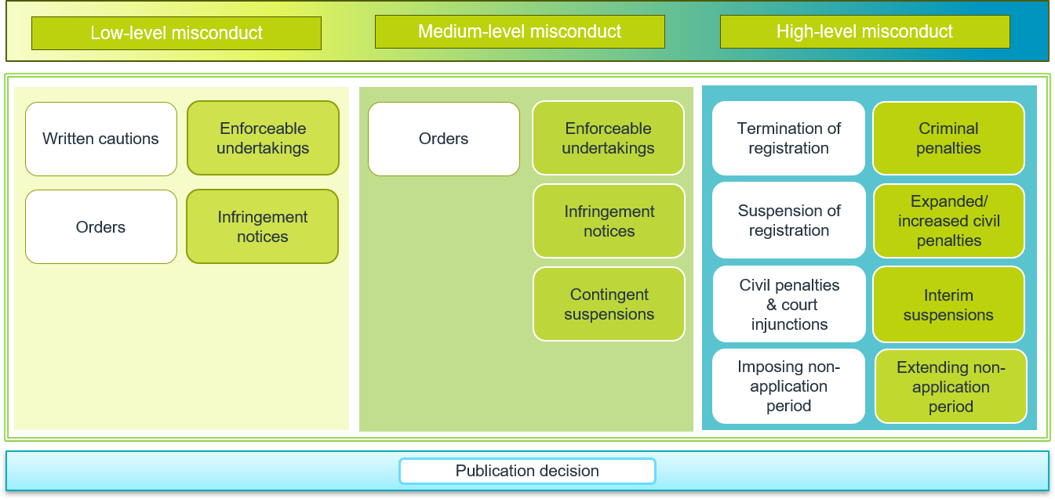
We can continue to apply one or more sanctions, as appropriate and permitted under the TASA, depending on the type of misconduct.
New sanctions
New criminal penalties for unregistered entities
Criminal penalties apply to unregistered entities that engage in the following misconduct:
- providing tax agent or BAS services for a fee or other reward
- advertising tax agent or BAS services
- representing they are a registered tax agent or BAS agent.
Consistent with the civil penalty regime, exceptions will apply to certain services provided by legal practitioners, customs brokers and voluntary services.
The maximum penalty that can be imposed for each criminal offence will be 40 months imprisonment or 200 penalty units (or both). The value of a penalty unit is $364 as at 1 October 2026.
This sanction is intended to target serious contraventions and will give us the choice to pursue civil or criminal penalties for misconduct that poses a high risk to the tax system, depending on the most appropriate compliance response.
New civil penalties
If a registered tax practitioner or unregistered entity contravenes a civil penalty provision in the TASA, we can apply to the Federal Court for an order that a civil penalty be imposed. A civil penalty is a pecuniary (monetary) penalty imposed by a court in civil proceedings.
New civil penalties have been introduced into the TASA for the following contraventions:
| Type of entity | Conduct | Civil penalty provision |
|---|---|---|
| Registered tax practitioners | Each breach of the Code of Professional Conduct (Code) or Code Determination | Section 50-31 |
| Unregistered entity | Making of false or misleading statements to TPB or Australian Taxation Office (ATO) | Section 50-21 |
These penalties apply in addition to the current civil penalties:
| Type of entity | Conduct | Civil penalty provision |
|---|---|---|
| Registered tax practitioners | Making false or misleading statements to ATO | Section 50-20 |
| Employing or using the services of deregistered entities in certain circumstances | Section 50-25 | |
| Signing a declaration or statement for a taxpayer prepared by an entity that is not registered or working under their supervision and control | Section 50-30 | |
| Unregistered entity | Providing tax agent services or BAS services for a fee or other reward | Section 50-5 |
| Advertising tax agent services or BAS services | Section 50-10 | |
| Representing they are a registered tax agent or BAS agent | Section 50-15 |
We are able to apply for a civil penalty in relation to a contravention of the Code, if we are satisfied after conducting an investigation, that a registered tax practitioner has failed to comply with the Code.
For the making of false or misleading statements, the same conduct may also amount to a criminal offence under the Taxation Administration Act 1953. This will allow us to choose which type of penalty to pursue, depending on the circumstances. Consistent with the existing civil penalty regime, the same exceptions apply to certain services provided by legal practitioners.
Increased maximum civil penalty amounts
The maximum civil penalty amount that can be imposed by the Federal Court for a contravention of any of the civil penalty provisions in the TASA (including the new civil penalties) has increased:
| Type of entity | New maximum penalty | Previous maximum penalty |
|---|---|---|
| Individual (other than a significant global entity) | 2,500 penalty units | 250 penalty units |
| Body corporate (other than a significant global entity) | 50,000 penalty units | 1,250 penalty units |
| *Significant global entities | 50,000 penalty units | Same as an individual or body corporate |
*A significant global entity (SGE) generally refers to a body corporate, partnership or trust that has an annual global income of $1 billion or more.
For partnerships and trusts that are SGEs, the maximum penalty for body corporates will apply to each partner/trustee, regardless of whether they are an individual or body corporate.
Infringement notices
We can issue an infringement notice to:
- a registered tax practitioner – if we are satisfied, after conducting an investigation, that they have failed to comply with one of the prescribed provisions in the Code.
- to a registered tax practitioner or unregistered entity – if we believe on reasonable grounds that they have contravened one of the other prescribed civil penalty provisions in the TASA.
These provisions, collectively referred to as ‘infringement notice provisions’, cover:
| Provision | Conduct |
|---|---|
| Registered tax practitioners | |
| Section 50-30 | Signing of certain declarations/statements |
| Section 50-31 | Breach of Code of Professional Conduct – due to failure to comply with: |
| Code item 2: | Compliance with taxation laws in conduct of personal affairs |
| Code item 3: | Accounting to client for money or property held on trust |
| Code item 6: | Disclosure of client information |
| Code item 8: | Maintaining knowledge and skills |
| Code item 12: | Advising client of rights and obligations |
| Code item 13: | Maintaining professional indemnity insurance |
| Code item 14: | Responding to Board requests and directions |
| Code item 17: |
|
| Provision | Conduct |
|---|---|
| Unregistered entities | |
| Section 50-5 | Providing tax agent services for a fee or other reward |
| Section 50-10 | Advertising tax agent services |
| Section 50-15 | Representing that you are a registered tax practitioner |
| Section 50-17 | Providing tax (financial) advice services |
| Section 50-18 | Advertising tax (financial services) if not registered or qualified |
The standard framework in the Regulatory Powers (Standard Provisions) Act 2014 applies to our infringement notice regime.
An infringement notice must be issued within the following timeframes:
- registered tax practitioner – 12 months of the date of the contravention
- unregistered entity – 2 years of the date of the alleged contravention.
The maximum penalty payable is the lesser of:
- 12 penalty units if the entity is an individual, or 60 penalty units if the entity is a body corporate (including a significant global entity); and
- one-fifth of the maximum penalty that a court could impose for the contravention or alleged contravention.
The entity can choose whether to pay the penalty amount specified in the notice. Payment does not constitute an admission of guilt or liability. However, if the amount is paid, the entity’s liability for the contravention or alleged contravention is discharged.
If the amount is not paid, we may decide to commence court proceedings in relation to the contravention or alleged contravention, depending on the circumstances.
The penalty must be paid within 28 days of the day after the notice is given, subject to any application for an extension to pay that is approved by us. In certain circumstances, the entity can also apply to have the notice withdrawn.
An infringement notice is a compliance tool generally used for relatively minor or less serious contraventions or alleged contraventionsof the TASA.
Enforceable undertakings
We can enter into enforceable undertakings (EUs) with registered tax practitioners and unregistered entities.
An enforceable undertaking (EU) is a written agreement between us and a registered tax practitioner or unregistered entity, in which they voluntarily agree to comply with certain terms relating to compliance with the TASA.
The standard framework in the Regulatory Powers (Standard Provisions) Act 2014 applies to our EU regime.
We may accept an EU from an entity to:
- take specified action – in order to comply with a provision of the TASA
- refrain from taking specified action – in order to comply with a provision of the TASA, or
- take specified action – to help ensure that they do not contravene, or are unlikely to contravene, a provision of the TASA.
We will generally only accept an EU in situations where we consider it will improve and enforce compliance with the TASA.
We can only accept an EU in relation to a failure to comply with the Code if we have conducted an investigation and made a finding that there has been a breach.
Once accepted by us, the EU is enforceable. If an EU is not complied with, we can apply to the Federal court for an order, including enforcement of compliance and financial penalties.
Interim suspensions
We can immediately suspend a tax practitioner’s registration for up to 90 days, without having to commence or finalise an investigation, if we are satisfied on reasonable grounds that both the following criteria are met:
| Condition 1 | Condition 2 |
|---|---|
The registered tax practitioner has engaged in conduct that may constitute:
| Having regard to the conduct:
|
We can extend an interim suspension for up to a further 90 days at a time, provided
- we are satisfied the above criteria continue to be met, and
- an investigation has commenced.
This sanction enables us to act quickly in response to egregious behaviour:
- to prevent further harm to clients, the community, the tax profession and/or the broader tax system, while we investigate further
- in the interests of protecting consumers and deterring extreme misconduct.
Contingent suspension
We can suspend a tax practitioner’s registration if:
- an event affecting their continued registration occurs
- they cease to meet one of the registration eligibility requirements for tax agents and BAS agents, or
- they breach a condition of their registration.
This sanction provides an alternative to us terminating registration on the same grounds. We can decide to suspend or terminate registration as appropriate, having regard to the circumstances, including the nature and severity of the tax practitioner’s conduct.
The tax practitioner’s registration is suspended until we are satisfied that they have remedied the relevant non-compliance and we have lifted the suspension.
An entity can apply to us to have their suspension lifted if they provide evidence that the actions required to lift the suspension have been met and any documentation that we require
Extension of non-application (banning) period on termination
The maximum period we can determine that a tax practitioner cannot apply for registration after being terminated by us has been extended from 5 years to 10 years.
This extended period applies where the termination of registration occurs on or after 1 October 2026 (and relates to conduct that also occurs on or after this date).
In addition, an entity will be treated as a disqualified entity and remain prevented from providing tax agent services or BAS services on behalf of a registered tax practitioner without our approval, for the whole of the non-application period, including where it exceeds 5 years.
Last modified: 23 October 2026